

Quantum Sensors Market to Cross USD 2.56 Billion by 2035, Rising from USD 0.82 Billion in 2025
Quantum Sensors Market
Quantum Sensors Market Size, Share and Research Report By Product Type (Atomic Clocks, Quantum Magnetometers, Quantum Gravimeters & Gradiometers
The Quantum Sensors Market is gaining momentum as advancements in quantum technology enable ultra-precise measurement applications across healthcare, defense, and industrial sectors.”
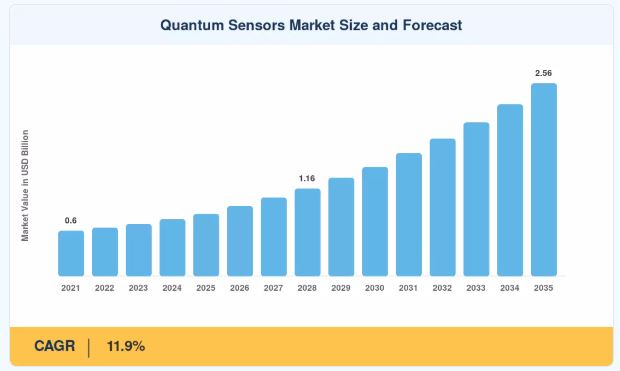
BERLIN, BERLIN, GERMANY, July 30, 2026 /EINPresswire.com/ -- The Global Quantum Sensors market was estimated at USD 0.82 billion in 2025 and is projected to grow from USD 0.93 billion in 2026 to USD 2.56 billion by 2035, registering a CAGR of 11.9% during the forecast period. The market is currently experiencing a transformative phase, driven by advancements in quantum technology and increasing demand across sectors such as healthcare, telecommunications, and defense. The growing emphasis on precision measurement and enhanced sensitivity is propelling innovations, leading to the development of new applications that were previously unattainable, with quantum gravimeters and magnetometers increasingly used to enhance navigation systems and geological surveys.— Market Research Future (MRFR)
As industries recognize the potential of quantum sensors, investments in research and development are surging, fostering a competitive landscape that encourages collaboration among key players. In 2025 alone, R&D spending in quantum technologies is estimated to exceed USD 2 billion, reflecting a broad commitment to advancing the field. The integration of quantum sensors into existing systems is a focal point for many organizations, suggesting a shift toward hybrid solutions that combine classical and quantum technologies to enhance overall performance.
North America is the largest market for quantum sensors, holding approximately 45% of the global share, driven by significant investment from government agencies and private-sector leaders including IBM, Google, and Honeywell. Europe holds roughly 30% of global share, anchored by the Quantum Flagship program and strong contributions from Germany and the UK, while Asia-Pacific accounts for approximately 20% of global share and is emerging as a significant growth engine on the back of Chinese and Japanese quantum research investment. As the market evolves, it is poised to redefine measurement standards and open new avenues for innovation across multiple domains.
Get Full PDF Sample Copy of Report: (Including Full TOC, List of Tables & Figures, Chart) @
https://www.marketresearchfuture.com/sample_request/5273
➤ How Significant Is the Quantum Sensors Market's Growth?
The quantum sensors market's trajectory from USD 0.93 billion in 2026 to a projected USD 2.56 billion by 2035 represents more than a four-and-a-half-fold expansion over the forecast decade, reflecting the transition of quantum sensing from a laboratory research curiosity into a commercially deployable technology across defense, energy, healthcare, and industrial applications. The market's 11.9% CAGR is anchored in rapid technology maturation: innovations built on quantum entanglement and superposition principles are producing sensors capable of detecting minute changes in environmental conditions that classical sensors cannot resolve.
Atomic Clocks command the largest product-segment share, owing to their established applications in telecommunications and global positioning systems, while Gravity Sensors are the fastest-growing product category, driven by increasing demand in geological and geophysical applications such as oil and gas exploration and subsurface structural analysis. By vertical, Oil & Gas holds the largest share as the sector continues to invest in high-precision exploration technologies that improve drilling and reservoir-management decisions, while Military & Defense is the fastest-growing vertical, leveraging quantum sensing for secure communications and advanced navigational aids. North America leads all regions with roughly 45% of global share, Europe follows at approximately 30%, and Asia-Pacific rounds out the leading growth regions at approximately 20% of global share.
➤ What Does the Future Hold for the Quantum Sensors Market?
Advancements in quantum technology are propelling the quantum sensors market forward. Innovations in quantum computing and quantum communication are creating new opportunities for sensor development, and the integration of quantum entanglement and superposition principles is leading to highly sensitive sensors that can detect minute changes in environmental conditions. This technological evolution is expected to enhance the performance of quantum sensors while making them more accessible and cost-effective, driving an influx of new products and applications across industries.
Growing demand for precision measurement is a second major driver: industries such as aerospace, defense, and telecommunications are increasingly relying on quantum sensors for their unparalleled accuracy and sensitivity, with quantum gravimeters and magnetometers already being utilized to enhance navigation systems and geological surveys. The integration of quantum sensors with the Internet of Things is emerging as a transformative trend, allowing for enhanced data collection and analysis that enables smarter decision-making in applications such as agriculture and energy resource management. Rising applications in environmental monitoring are also expanding the addressable market, as quantum-based sensors provide real-time data on greenhouse gas emissions and atmospheric conditions that aid regulatory compliance and climate-change response efforts.
Increased investment in research and development continues to underpin the market's growth outlook. Governments and private entities are allocating substantial funds to explore the potential of quantum technologies, with initiatives aimed at developing quantum networks and enhancing sensor capabilities gaining traction worldwide. New opportunities are emerging in quantum-enhanced imaging systems for medical diagnostics, integration of quantum sensors into autonomous-vehicle navigation systems, and the creation of portable quantum sensors for environmental monitoring and data collection developments that are expected to solidify the market's role across sectors by 2035.
Get access to the full description of the report @
https://www.marketresearchfuture.com/reports/quantum-sensors-market-5273
➤ Who Are the Key Players in the Quantum Sensors Market?
The quantum sensors market is currently characterized by a dynamic and moderately fragmented competitive landscape, driven by rapid technological advancements and increasing demand across telecommunications, healthcare, and defense. A mix of established technology conglomerates and emerging quantum-specialist startups fosters a diverse range of products and services, with competitive differentiation increasingly centered on innovation and technological advancement rather than price. MRFR identifies the following key participants:
★ IBM (US) - focuses on integrating quantum computing with sensor technology, aiming to develop solutions that significantly improve data accuracy and processing speed, and has launched a quantum sensor platform that incorporates advanced machine-learning algorithms to enhance sensor accuracy.
★ Honeywell (US) - emphasizes partnerships and collaborations to expand its product offerings and enhance operational capabilities in industrial applications, including a strategic partnership with a leading aerospace company to develop quantum sensors for navigation and positioning systems.
★ Microsoft (US) - contributes to the market's technological advancement through its broader quantum computing research program, applying its platform and cloud infrastructure to quantum sensing applications.
★ Google (US) - continues to invest heavily in research and development, unveiling a quantum sensor prototype that reportedly achieves unprecedented sensitivity levels and positions the company as a leader in the quantum sensing space.
★ Rigetti Computing (US) - applies its quantum computing hardware expertise toward sensing applications, contributing to the broader ecosystem of US-based quantum technology innovation.
★ D-Wave Systems (CA) - a Canadian quantum technology leader contributing to the competitive landscape alongside fellow Canadian innovator Xanadu, reinforcing Canada's position within the North American quantum ecosystem.
★ QinetiQ (GB) - a leading UK-based player supporting Europe's quantum sensing ecosystem alongside significant academic contributions from British and German research institutions.
★ Toshiba (JP) - advances quantum sensor technologies from Japan, contributing to Asia-Pacific's growing role in quantum research and development.
★ NIST (US) - the National Institute of Standards and Technology plays a foundational role through funding initiatives and standards-setting work that catalyzes broader market expansion.
★ Xanadu (CA) - a Canadian quantum technology innovator contributing to a robust ecosystem for quantum technology development in North America.
Strategic competition in the quantum sensors market is increasingly defined by digitalization, sustainability, and the integration of artificial intelligence, with strategic alliances becoming more prevalent as companies recognize the value of collaboration in driving innovation and expanding market reach. Competitive differentiation is expected to shift from traditional price-based competition toward technological innovation, supply-chain reliability, and the ability to deliver sustainable solutions.
➤ What Are the Emerging Trends in the Quantum Sensors Market?
Several transformational trends are redefining the quantum sensors market's evolution through 2035:
Technological Advancements: Recent innovations in quantum technology are significantly enhancing the sensitivity and accuracy of quantum sensors, making them more appealing for a broadening range of applications.
Increased Adoption in Healthcare: The healthcare sector is increasingly recognizing the potential of quantum sensors for medical imaging and diagnostics, indicating a growing reliance on advanced measurement techniques to improve patient outcomes.
Focus on Hybrid Solutions: There is a noticeable trend toward integrating quantum sensors with traditional technologies, an approach that may offer enhanced performance and broaden the scope of applications across a wider range of industries.
Quantum-Enhanced Imaging and Autonomous Navigation: The development of quantum-enhanced imaging systems for medical diagnostics and the integration of quantum sensors into autonomous-vehicle navigation systems represent significant new-opportunity vectors for the market.
Portable Quantum Sensors for Environmental Monitoring: The creation of portable quantum sensors for environmental monitoring and data collection is opening new deployment models beyond fixed laboratory or industrial installations.
Integration with the Internet of Things: Combining quantum sensors with IoT platforms enables high-resolution, real-time data collection that supports predictive analytics and optimized resource management in agriculture and energy applications.
Buy Full Research Report:
https://www.marketresearchfuture.com/checkout?currency=one_user-USD&report_id=5273
➤ How Is the Quantum Sensors Market Segmented?
The quantum sensors market report provides a comprehensive segmentation framework:
By Product: Atomic Clocks (largest segment), Photosynthetically Active Radiation (PAR) Sensors, Gravity Sensors (fastest-growing), Magnetic Sensors, Quantum Sensors
By Vertical: Oil & Gas (largest segment), Military & Defense (fastest-growing), Automotive, Healthcare, Agriculture
By Region: North America (~45% share), Europe (~30% share), Asia-Pacific (~20% share), Middle East & Africa (~5% share)
➤ What Are the Regional Insights from the Quantum Sensors Market?
North America is the largest market for quantum sensors, holding approximately 45% of the global share. The region's growth is driven by significant investments in research and development, particularly from government agencies and private-sector leaders, with regulatory support such as funding initiatives from the National Institute of Standards and Technology further catalyzing market expansion. The United States leads the market, with key players like IBM, Google, and Honeywell spearheading innovation, while Canada follows closely, with companies like D-Wave Systems and Xanadu contributing to a robust ecosystem for quantum technology development.
Europe is witnessing rapid growth in the quantum sensors market, holding approximately 30% of the global share. The region benefits from strong governmental support and collaborative initiatives such as the Quantum Flagship program, which aims to accelerate quantum technology development. Germany is a leading player, supported by companies like QinetiQ and significant academic contributions from research institutions, while the UK also plays a crucial role through university- and startup-driven quantum technology initiatives, creating a competitive landscape characterized by a mix of established firms and innovative startups.
Asia-Pacific is emerging as a significant player in the quantum sensors market, accounting for approximately 20% of global share. The region's growth is fueled by increasing investments in quantum research and development, particularly in China and Japan, alongside government initiatives aimed at fostering innovation and collaboration in quantum technologies, with a focus on applications in telecommunications and environmental monitoring. China is leading the charge with substantial funding for quantum research and development, while Japan is home to companies like Toshiba that are advancing quantum sensor technologies, creating a dynamic market environment shaped by both government-backed initiatives and private-sector investment.
The Middle East and Africa region is in the nascent stages of developing its quantum sensors market, currently holding about 5% of the global share. Growth is driven by increasing interest in advanced technologies and government initiatives aimed at diversifying economies, with countries like the UAE investing in technology sectors including quantum research to enhance global competitiveness and innovation capabilities. While the market remains in its early stages, there is growing recognition of the potential applications of quantum sensors in sectors such as oil and gas, healthcare, and environmental monitoring, with a competitive landscape characterized by emerging startups and collaborations with international firms.
➤➤➤ Related Reports by Market Research Future:
Smart Grid Sensors Market
https://www.marketresearchfuture.com/reports/smart-grid-sensors-market-5427
Power Over Ethernet Market
https://www.marketresearchfuture.com/reports/power-over-ethernet-market-2091
Sic Power Semiconductor Market
https://www.marketresearchfuture.com/reports/sic-power-semiconductor-market-6441
Vcsel Market
https://www.marketresearchfuture.com/reports/vcsel-market-8672
Total Stations Market
https://www.marketresearchfuture.com/reports/total-stations-market-5727
Gaming Monitors Market
https://www.marketresearchfuture.com/reports/gaming-monitors-market-11883
Europe Building Automation Systems Market
https://www.marketresearchfuture.com/reports/europe-building-automation-system-market-13929
Asia-Pacific Industrial Automation Market
https://www.marketresearchfuture.com/reports/asia-pacific-industrial-automation-market-13944
Us Robotics Market
https://www.marketresearchfuture.com/reports/us-robotics-market-13943
Plasma Etching Equipment Market
https://www.marketresearchfuture.com/reports/plasma-etching-equipment-market-17760
Sagar Kadam
Market Research Future
+ + +1 628-258-0071
email us here
Legal Disclaimer:
EIN Presswire provides this news content "as is" without warranty of any kind. We do not accept any responsibility or liability for the accuracy, content, images, videos, licenses, completeness, legality, or reliability of the information contained in this article. If you have any complaints or copyright issues related to this article, kindly contact the author above.
